If you run finance for a restaurant group and you have started shopping for something to fix accounts payable, two names show up on every shortlist: MarginEdge and Restaurant365. They are the two best known restaurant-native platforms, they both ingest vendor invoices, and they both promise a faster close.
They are also priced on a model that most finance leads are not expecting. Horizontal AP tools charge per user. These two charge per location. That single difference is what decides which one is cheaper for you, and it is the part the comparison articles tend to skip.
This guide lays out what each company publishes today, works the total cost at three group sizes, and is honest about the case where neither is the right purchase.
The pricing models are not comparable on their face
A per-user price scales with how many people touch the system. A per-location price scales with how many restaurants you operate. Those two curves cross somewhere, and where they cross depends on a ratio nobody asks about during a demo: how many approvers you have per location.
A single restaurant with a chef, a general manager, a bookkeeper, and an owner who all need to see bills has four users and one location. A twelve-unit group where every invoice routes to one controller and one regional manager has two users and twelve locations. Those two businesses get wildly different answers, and both of them are common.
So the first thing to do is not to compare prices. It is to count your locations and count the people who actually need a login, then run the arithmetic twice.
Per-location pricing is not a markup. It is a bet that your headcount grows faster than your unit count. If you are a small group with a lot of approvers, that bet pays off for you. If you are a growing group with a lean back office, it does not.
MarginEdge: what the published rate covers
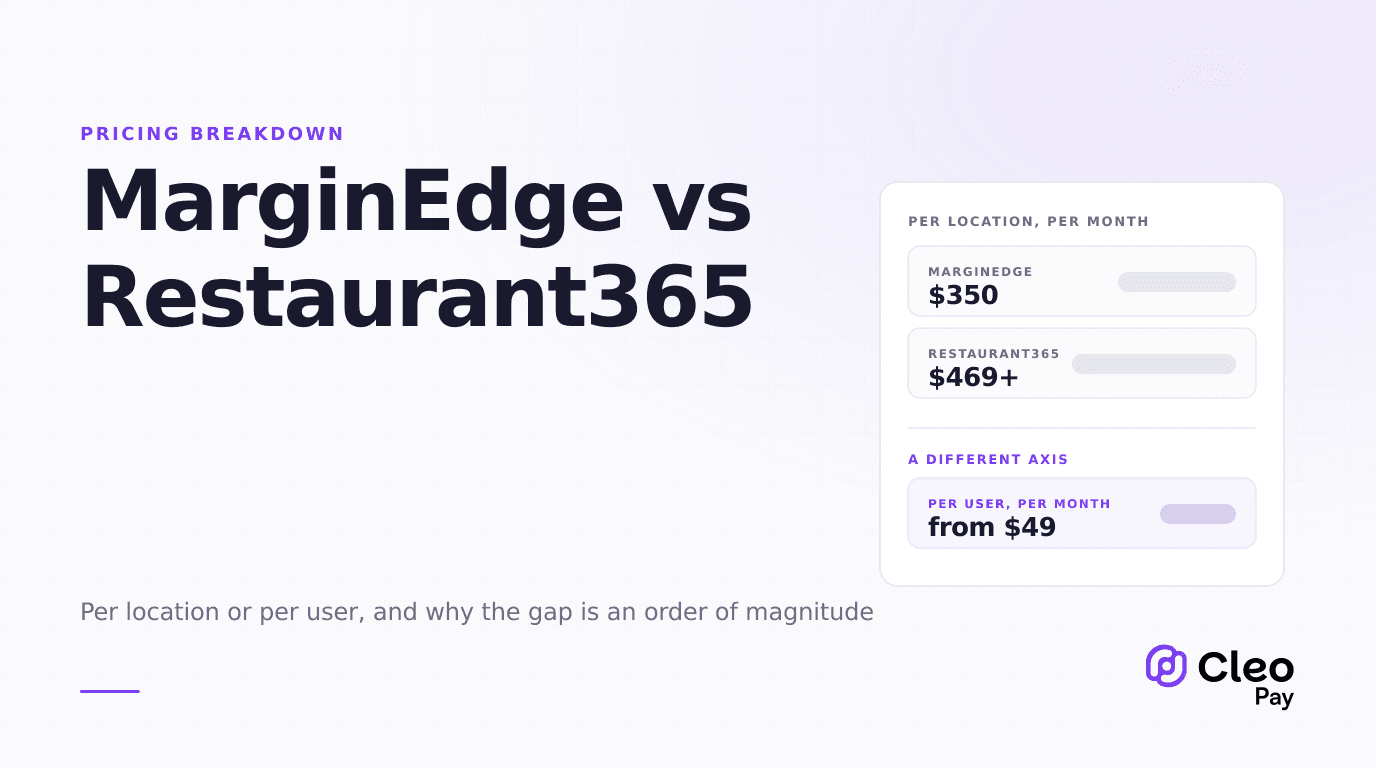
MarginEdge publishes its price openly, which is genuinely unusual in restaurant technology and worth crediting. The rate is $350 per location per month. Billing is monthly, or annually for a 10 percent discount, which the company describes as saving $420 a year on a single location. That figure is consistent with the arithmetic: $350 across twelve months is $4,200, and ten percent of that is $420.
Users are not metered. You can put every manager, chef, and bookkeeper in the system on that one per-location rate, which is the main reason MarginEdge often wins on price for small groups with wide approval chains.
MarginEdge also sells a beverage program add-on called Freepour, at an additional $150 per location per month. That is a separate product rather than an AP feature, but it is worth knowing about, because the $350 you were quoted becomes $500 if it gets bundled into the proposal.
The important architectural point is that MarginEdge is not your accounting system. It sits in front of whatever you already run, ingests invoices, codes them, and pushes the results into your general ledger. If you are happy with QuickBooks or Sage and want to keep it, that is a feature, not a limitation. Our guide to restaurant bill pay software walks through why that layered approach tends to survive implementation better than a replacement project.
Restaurant365: a different scope of purchase
Restaurant365 publishes a starting range for its Essential plan of roughly $469 to $499 per location per month. It also publishes an Accounting plus Operations bundle at $539 per location per month on annual billing, which is where the full AP automation suite, custom financial reporting, fixed assets, and business analytics live. Like MarginEdge, it includes unlimited users on a per-location rate.
The exact number you are quoted depends on unit count, which modules you select, implementation scope, and support level. Restaurant365 is explicit that the published figures are starting points rather than a final price, so treat them as the floor of a range.
What you are buying is also different in kind. Restaurant365 is designed to become your accounting system, not to sit beside it. It carries accounts receivable, fixed assets, and franchise accounting, and there are workforce modules for hiring, payroll, and HR available on top. For a group that is tired of stitching a restaurant ops tool to a general ledger to a scheduling app, consolidation is the entire value proposition.
That is also the honest tradeoff. Replacing your accounting system is a materially larger project than layering something in front of it. Implementation is a real line item, the timeline is longer, and your controller's year is going to look different. Neither company is wrong about its approach; they are selling to different appetites for change.
The third option most shortlists leave off
There is a category that does not appear in a MarginEdge versus Restaurant365 search, and it is often the cheapest correct answer: a horizontal AP tool sitting beside the accounting system you already run.
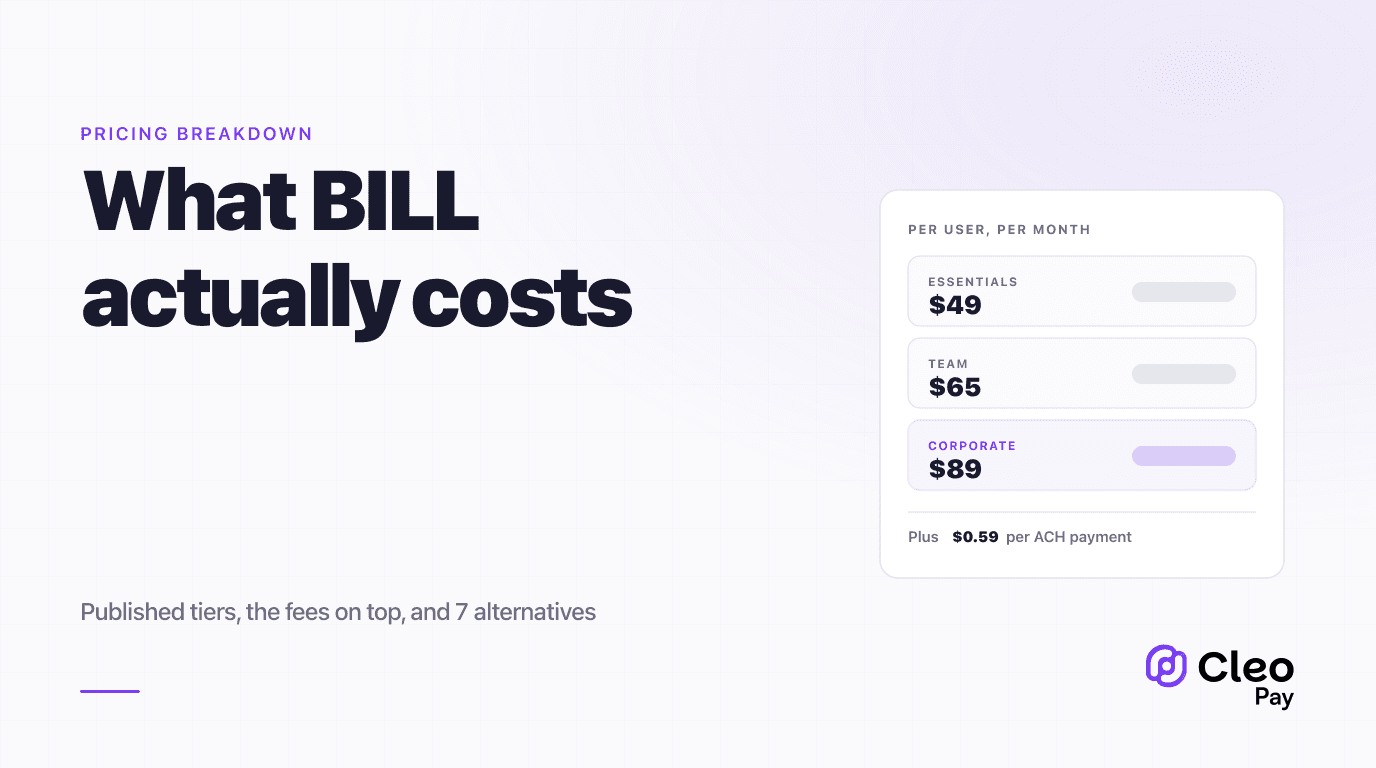
BILL publishes an Essentials plan starting at $49 per user per month and a Corporate plan at $89 per user per month with procurement included, with custom pricing above that for multi-entity and enterprise setups. Per-transaction fees apply to certain payment types regardless of which plan you are on, so the subscription is not the whole bill. We broke the full picture down in our guide to BILL's 2026 pricing and its alternatives.
What you give up is the restaurant-native layer. Neither BILL nor any other horizontal tool does recipe costing, plate-level margin analysis, or theoretical versus actual food cost. If those are why you are shopping, a horizontal tool will not satisfy you and you should not buy one.
What you gain is a much smaller bill when your unit count is high and your login count is low. If your AP problem is genuinely "invoices arrive as paper, coding is manual, and approvals happen by text message," that is an AP problem, not a restaurant-operations problem, and you can solve it for a fraction of a per-location platform. Our note on where QuickBooks Bill Pay breaks for restaurants covers the narrower version of this question.
Worked totals at three group sizes
Every figure below is the published list rate multiplied out. No discounts, no implementation, no add-ons. Treat it as the starting point of a negotiation rather than a quote.
One location. MarginEdge is $350 a month, or $4,200 a year. Restaurant365 Essential at the bottom of its published range is $469 a month, or $5,628 a year. The gap is about $1,400 annually, which is small enough that scope, not price, should decide it.
Four locations. MarginEdge is $1,400 a month, or $16,800 a year. Restaurant365 at $469 is $1,876 a month, or $22,512 a year. The annual gap is now about $5,700, and the Accounting plus Operations bundle at $539 would put Restaurant365 at $25,872.
Twelve locations. MarginEdge is $4,200 a month, or $50,400 a year. Restaurant365 at $469 is $5,628 a month, or $67,536 a year. At this size both companies are almost certainly discounting, which is exactly why you should ask for the multi-unit rate rather than reasoning from list.
Now run the same twelve locations through a per-user tool. If your back office is a controller, an AP clerk, and two regional managers, that is four seats. BILL Essentials at $49 is $196 a month, or $2,352 a year, plus per-transaction fees. That is not a small difference from $50,400. It is an order of magnitude, and it is the whole reason the third category deserves a place on the shortlist.
The honest caveat: those numbers are not buying the same thing. The per-location platforms are buying you food cost management. If you need that, the comparison is not fair and you should ignore it. If you do not, the comparison is the most important one in this article.
The 1099 question these comparisons skip
Restaurants pay individuals, not just companies. Musicians, private event staff, contract cleaners, repair techs, delivery drivers, and consultants all land in accounts payable and all turn into tax reporting in January. Whether your AP platform handles that is a real selection criterion, and it rarely appears in a feature grid.
Two things changed for 2026 and both matter here. The reporting threshold for Form 1099-NEC rose from $600 to $2,000 for payments made after December 31, 2025, under Section 70433 of the One Big Beautiful Bill Act, and it will be indexed for inflation after 2027. The threshold for backup withholding rose alongside it.
That does not make the problem go away. Backup withholding is still 24 percent on reportable payments when you do not have a correct taxpayer identification number on file, which means the W-9 has to be collected before the first payment goes out, not the following January. A higher threshold reduces the number of forms you file; it does not reduce the need to know who you are paying.
Our write-up of the threshold change goes through what it means for AP workflows in more detail.
What to confirm before you sign
A note on the last item. Invoice line-item history is the asset you are building inside these platforms, and it is what makes switching painful later. Ask about export format at the start, when you have leverage, rather than at the end when you do not.
How Cleo Pay compares
Cleo Pay is a payables platform for hospitality operators, and it is priced per month with payments included rather than per location. Published pricing is Free for vendors and contractors receiving payments, Basic at $99 a month for 15 payments and one seat, Plus at $199 a month for 50 payments, three seats, next-day ACH, and automated 1099 filing, and Pro at $299 a month for 100 payments, ten seats, and dedicated support. Additional payments are $3, $2.50, and $2 respectively depending on tier.
Where that helps: a group with several locations and a small back office pays for payment volume rather than for door count, and the 1099 filing is in the product rather than bolted on. A twelve-unit operator running a hundred payments a month through one controller and a regional approver is comparing $299 against a per-location figure in the thousands.
Where it does not: Cleo Pay does not do recipe costing, plate-level margin analysis, or theoretical food cost, and it is not an accounting system. If those are the reasons you started this search, MarginEdge or Restaurant365 is the better purchase and we would rather you buy the right thing.
The short version
MarginEdge is the cheaper of the two restaurant-native platforms on published rates and the smaller implementation, because it layers in front of your accounting system instead of replacing it. Restaurant365 costs more and asks more of your team, and in exchange it consolidates accounting, operations, and optionally workforce into one system. Both price per location with unlimited users, so both get more expensive as you open doors and neither gets more expensive as you add approvers.
The question worth asking before either demo is whether you are buying food cost management or accounts payable. If it is food cost management, pick between these two on scope and appetite for change, and negotiate hard above ten units. If it is accounts payable, a tool priced per user or per payment will likely cost an order of magnitude less, and you should put one on the shortlist before you sign anything per location.
If you want to see what per-payment pricing looks like against a per-location quote you are already holding, get started with Cleo Pay and we will walk your own numbers through it. Our accounts payable and restaurants pages cover what the product does in more detail.