For roughly four decades, $600 was the number. Pay a contractor $600 or more in a year and you owed them a 1099. Every AP process, every year-end checklist, every bookkeeper's mental model was built around it.
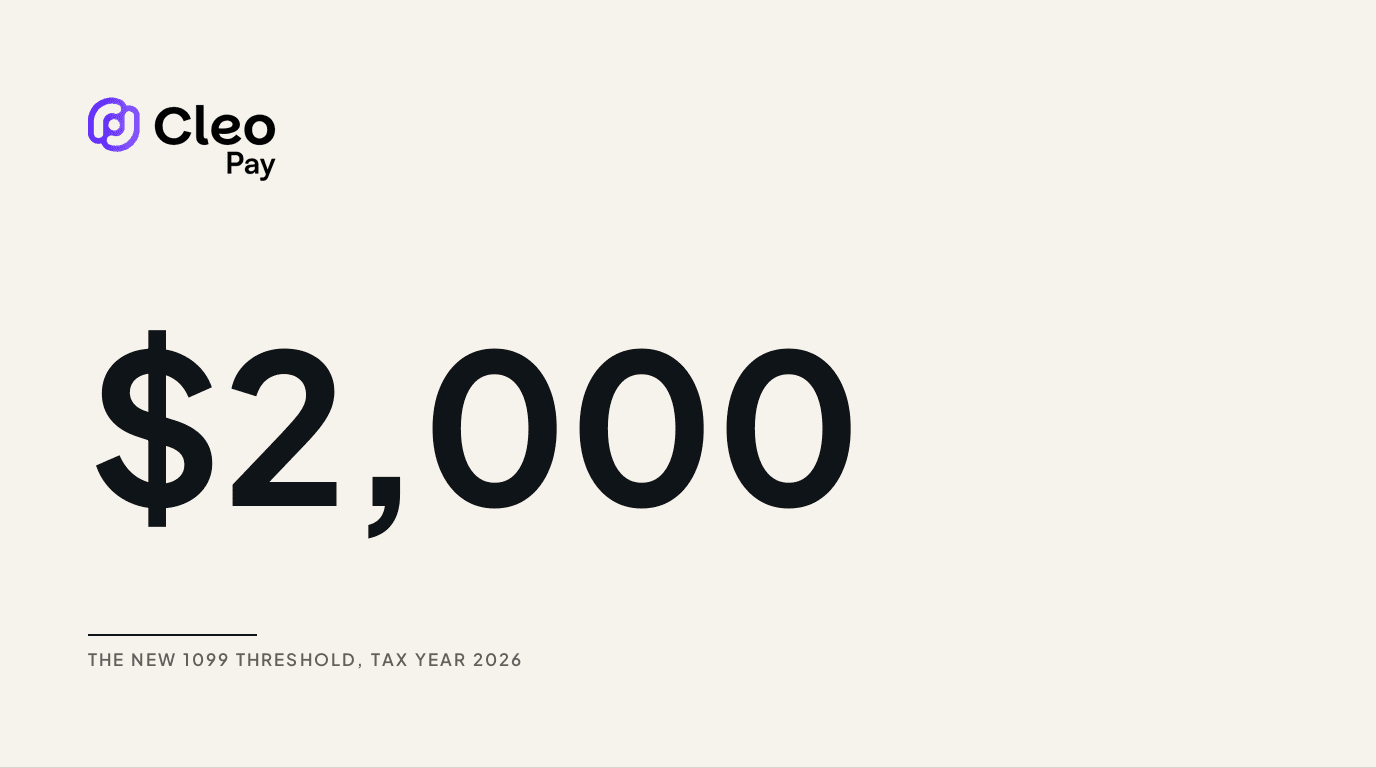
That number changed. For payments made during 2026 and after, the reporting threshold for Forms 1099-NEC and 1099-MISC is $2,000.
The change itself is simple. The part that causes real problems is the timing, because "2026" means something different depending on whether you are talking about the year you paid someone or the year you file the form. Most of the confusion we see comes from collapsing those two into one.
What actually changed
The One Big Beautiful Bill Act, signed on July 4, 2025, raised the minimum reporting threshold in sections 6041 and 6041A of the tax code from $600 to $2,000. The IRS states it plainly in the Instructions for Forms 1099-MISC and 1099-NEC:
For tax years beginning after 2025, the minimum threshold amount for reporting certain payments required to be reported on certain information returns and/or perform backup withholding on those payments increased to $2,000 and may be adjusted for inflation beginning in calendar year 2027.
Two things in that sentence are easy to skim past.
First, the increase covers backup withholding as well as reporting. This is not purely a paperwork threshold.
Second, "may be adjusted for inflation beginning in calendar year 2027" means $2,000 is a starting point, not a permanent figure. If you are writing internal documentation, a vendor policy, or a training doc, do not hard-code $2,000 as a rule that holds forever. Write it as "the threshold for the current tax year" and keep the figure in one place you can update.
The timing trap: tax year is not filing year
This is the single most common way to get the change wrong, and it is worth being pedantic about.
A 1099 covers payments made during a calendar year. You file it early in the following year. So there are always two years in play, and people routinely name the wrong one.
Read that against today. It is August 2026. Every contractor payment you make right now falls under the $2,000 threshold and will be reported on a form due in early 2027. The 1099s that went out of your office back in January covered 2025 and correctly used $600.
Where this goes wrong in practice: someone hears "the new threshold starts in 2026," looks at the 1099s they filed in January 2026, and concludes those should have used $2,000. They did not. Those forms covered 2025.
The 1099-NEC deadline is January 31 for both the recipient copy and the IRS copy. When January 31 falls on a weekend or holiday, the deadline moves to the next business day. January 31, 2027 is a Sunday, so forms covering 2026 payments are due Monday, February 1, 2027.
A higher threshold does not make income tax free
This is the misreading most likely to hurt someone, and it is worth saying to your contractors directly if the topic comes up.
The threshold governs your obligation to file an information return. It has nothing to do with whether the person you paid owes tax. A contractor who earns $1,800 from you in 2026 will not receive a 1099-NEC, and still owes income and self-employment tax on that $1,800. All income is taxable whether or not a form documents it.
The practical consequence is that more income now moves without a paper trail flowing to the IRS. Contractors who relied on the stack of 1099s in their mailbox as an informal bookkeeping system are going to find that stack thinner, while their actual reporting obligation is unchanged. If you work with a lot of small-dollar contractors, a short, neutral note explaining this is a reasonable thing to send. Just be careful to keep it informational and point them to their own accountant rather than advising them on their return.
What did not change
Plenty of the surrounding rules are untouched, and assuming otherwise causes its own errors.
- Gross proceeds paid to an attorney stay at $600, reported in box 10 of Form 1099-MISC. The increase did not raise this one. Note the split: attorneys' fees paid in the course of your trade or business follow the $2,000 rule, while gross proceeds in a settlement do not.
- Royalties stay at $10.
- The backup withholding rate is still 24%. The threshold at which those rules bite moved to $2,000 along with the reporting threshold, but the rate itself is unchanged.
- Corporations are still generally exempt from 1099-NEC reporting, with the familiar exceptions for legal and medical services.
- W-9 rules are unchanged. Nothing about this raises the bar for collecting tax information.
- If you withheld federal income tax from a payment, file the 1099-NEC regardless of amount. The threshold does not apply.
- Form 1099-K is a separate regime with its own numbers. The same legislation restored the 1099-K threshold for third-party settlement organizations to more than $20,000 in gross volume and more than 200 transactions, with both tests required.
Your state may not have followed
Federal thresholds do not govern state filing, and states have not moved in unison. Several set their own numbers, and a contractor can trigger a state obligation with no matching federal one.
Per Thomson Reuters' review of state information reporting, the landscape for tax year 2026 includes:
There is a second-order problem worth planning for. States that wrote a static $2,000 into their own statutes without an inflation clause will match federal for a year or two and then quietly diverge once the federal figure starts indexing in 2027. A rule that is true in 2026 will not stay true.
If you pay contractors in more than one state, treat state thresholds as a per-state lookup you refresh annually, not a number you memorize. Your accountant or filing provider should be able to confirm the current figure for the states you actually file in.
What a business paying contractors should do
The honest answer for most operators is: change less than you might think, and change the right things.
The instinct after a threshold increase is to relax vendor onboarding, because fewer vendors will need forms. That instinct is wrong, and following it is how you end up in a January scramble. You do not know in March which vendors will cross $2,000 by December. A vendor you expected to use once ends up on three jobs. The safe default is unchanged: collect a W-9 from every vendor before the first payment, and let the reporting logic sort out who actually needs a form at year end.
What genuinely needs attention is anywhere the number $600 is hard-coded.
One more piece of housekeeping: if you run reports that compare 1099 volume year over year, expect a real drop in form count for 2026 that has nothing to do with your vendor activity. Label it so nobody reads it as a data problem.
Ready to simplify your AP workflow?
Get early access to Cleo Pay and see how we help hospitality teams save hours every week.
How Cleo Pay handles the change
Threshold tracking in Cleo Pay is tied to the tax year of the payment rather than a fixed number, so payments made during 2026 are measured against $2,000 while historical 2025 records keep the $600 logic they were filed under. Nothing needs to be reconfigured on your end, and prior-year records stay accurate for what they were.
W-9 collection is unchanged and stays deliberately unchanged: every vendor completes their tax information during onboarding, before the first payment clears, regardless of what you expect to pay them. That is the part of the process a higher threshold does not make safer to skip.
At year end, the 1099-eligible vendor list is filtered by entity type and payment total against the correct threshold for that year, with forms generated and filed from the payment records themselves. If you want the fuller picture of the compliance workflow, our 1099 compliance guide covers deadlines, classification, and the mechanics end to end.
The bottom line
The threshold moved from $600 to $2,000 for payments made in 2026 and after, it is indexed for inflation from 2027, and it will not hold still. Payments you make today get reported in early 2027 under the new number. Forms you filed in January covered last year and used the old one.
Your vendor onboarding should not change. Your hard-coded thresholds should. And the contractors you pay below the line still owe tax on every dollar of it.
If you want the threshold tracked correctly without maintaining it yourself, see how Cleo Pay works.