A hotel chart of accounts is not decided at month end. It is decided the moment someone picks a GL code on an invoice, usually in a hurry, usually without the schedule in front of them.
That is the whole problem. A property can adopt a perfectly structured account list and still produce financials nobody can benchmark, because the linen invoice went to Rooms when half of it was banquet linen, and the landscaping contract went to Property Operations when the grounds crew also maintains the golf course. The structure was right. The coding was not.
This matters more in 2026 than it did in 2025. The Uniform System of Accounts for the Lodging Industry, 12th Revised Edition, took effect on January 1, 2026, and several of its changes land squarely on the accounts payable desk rather than on the controller's reporting template.
If you are still deciding which system files those invoices in the first place, our buyer's guide to bill pay software for hotels covers the platform selection question. This guide assumes the platform is chosen and the invoices are arriving. The question here is where each one goes.
Why hotel coding is harder than restaurant coding
A single restaurant has one profit center and a handful of cost buckets. Our restaurant invoice categorization guide walks through that version of the problem, and most of its discipline carries over. Three things make a hotel meaningfully harder.
The property is many businesses under one roof. Rooms, food and beverage, spa, golf, parking, and retail each behave like a separate operating company with its own revenue, its own direct costs, and its own manager who is measured on the result.
Some costs belong to nobody in particular. The general manager's salary, the property insurance, the electricity bill, and the brand marketing fee do not belong to Rooms or to the spa. USALI puts them in a separate tier so that department managers are measured only on what they control.
Comparability is the entire point. A hotel's financials are read by an owner, an asset manager, a brand, a lender, and often a benchmarking service. The value of a uniform system is that a rooms department in one property can be compared against a rooms department in another. Miscoding does not just distort your own P&L. It removes you from the peer set.
The uniform system only produces comparable numbers if the coding at the invoice level is uniform too. A correct account list with inconsistent coding is a worse outcome than a rough account list applied the same way every month.
The three-bucket test
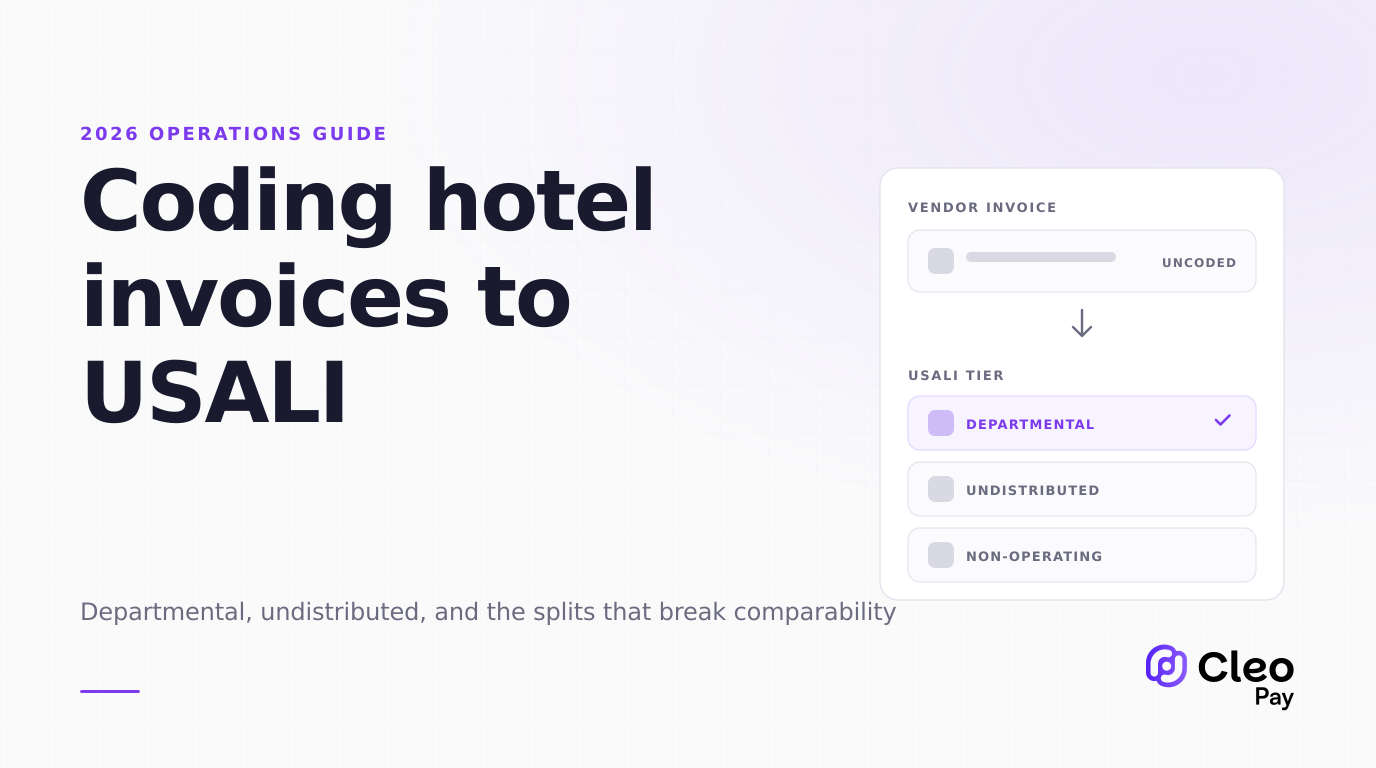
Before reaching for an account number, sort the invoice into one of three tiers. Almost every coding error is a tier error, not an account error.
Tier one: departmental expense. The cost is a direct operating expense of one operated department, and that department's manager controls it. Every operating department schedule reports on a responsibility basis, meaning the revenue and the direct expenses of running that department only, before any shared cost is pushed onto it. Guest room amenities, banquet food, spa product, and pro shop merchandise all live here.
Tier two: undistributed operating expense. The cost supports the whole property rather than one department. USALI groups these into their own schedules: Administrative and General, Sales and Marketing, Property Operations and Maintenance, Information and Telecommunications Systems, and the energy schedule. These are deliberately not allocated down to departments.
Tier three: non-operating income and expense. Rent, property taxes, insurance, interest, depreciation, and management fees sit below the operating result because they are ownership and financing outcomes rather than operating performance.
What the 12th edition changed for the AP desk
Most coverage of the 12th Revised Edition focuses on reporting and metrics. Several changes are really coding changes, because they alter which bucket an invoice lands in.
Utilities became Energy, Water and Waste. The Utilities Schedule was replaced by a new Energy, Water and Waste schedule, reflecting sustainability reporting practice. For AP this is mostly a relabeling, but waste hauling and water and sewer invoices now have an explicit home rather than being scattered between Utilities and Property Operations. If your account list still routes waste removal to maintenance, that is a mapping to revisit.
Executive and club lounge is its own schedule. In the 12th edition the executive or club lounge is a standalone schedule reported with the same level of detail as a food and beverage venue. Upcharge or premium revenue from paid lounge access, and the direct cost of running the lounge, no longer sit buried inside Rooms or F&B. Lounge food, beverage, and supply invoices that used to be coded to Rooms now need their own coding path.
Minor operated departments each stand alone. Schedule 3 covers other and minor operated departments such as spa, golf, parking, and marina, each carrying its own direct revenue and expense rather than being folded into a miscellaneous income line. A property that has been treating parking as an income line with no cost detail has coding work to do.
Labor hours became a mandatory schedule. The 12th edition added a mandatory labor-hours schedule. This is not an AP task for payroll, but it is one for contracted labor. If you use an outsourced housekeeping or stewarding vendor, the hours on that vendor invoice now have a reporting destination, which means the invoice needs to be coded in a way that preserves the hours, not just the dollars.
Brand and operator costs got their own schedule. A new brand and operator cost schedule separates what the brand and the management company charge from what the property spends on its own. Franchise fees, brand program charges, and operator reimbursables should be identified as such at intake rather than absorbed into Sales and Marketing or Administrative and General.
New line items for digital marketing, loyalty, and sustainability. The 12th edition added line items covering digital marketing expense, loyalty program benefits, and sustainability metrics. Agency invoices, paid search spend, and loyalty reimbursement charges now have a specific destination instead of a general advertising bucket.
Coding an invoice, decision by decision
Where common hotel invoices actually land
The table below covers the vendor invoices that generate the most coding disagreement in a full service property. Treat it as a starting map to adapt to your own account list, not as a substitute for your brand or management company's mapping guidance.
The split invoice problem
The invoices that cause the most damage are the ones that are genuinely multi department. A linen vendor delivers guest room linen and banquet linen on one ticket. A produce vendor supplies three outlets. A landscaping contract covers the entrance, the pool deck, and the golf course.
Coding these to a single department is the fastest path to departmental numbers nobody trusts. There are three ways properties handle it, and only one of them scales.
Code the whole invoice to the largest department. Fast, and wrong by a predictable amount every month. It systematically overstates one department's cost and understates another's. If you are benchmarking, this is the practice that pushes a property out of its peer set.
Journal it at close. The controller books a reclass entry each month to move the banquet share out of Rooms. This produces correct financials, but the correction lives in a journal entry rather than in the invoice record, so the AP detail and the P&L disagree. Anyone drilling from the statement into the invoice finds the wrong department.
Split at intake. The invoice is coded to multiple lines when it is entered, before approval. The AP record and the P&L agree, the department manager sees the charge in their own approval queue, and no month end correction is needed. This is the only version that survives volume growth or a second property.
Account numbering that survives a second property
If you are rebuilding the account list rather than just recoding into it, the numbering scheme deserves a decision up front. Our guide to chart of accounts numbering covers the general principles. Two are worth repeating for hotels specifically.
Leave gaps. The 12th edition added schedules, and the 13th will add more. An account list numbered consecutively with no room between entries forces either an ugly insertion or a renumber, and a renumber breaks every historical comparison and every integration mapping you have built.
Keep the department dimension separate from the account dimension. The natural instinct is to encode the department into the account number, producing a separate food cost account for every outlet. This multiplies the account list by the number of departments and makes consolidation across properties painful. Most modern accounting systems support a department or class dimension. Use it, and keep one food cost account coded to many departments rather than many food cost accounts.
A coding SOP the AP desk can actually follow
The reason coding drifts is rarely ignorance. It is that the person coding has no reference at the moment of decision and guesses to keep the queue moving. A short written standard, attached to the AP workflow rather than filed in a policy folder, fixes most of it.
What to look for in the system that files them
Coding discipline is mostly process, but the software either supports it or fights it. Four capabilities matter for a hotel specifically.
Line level splitting at intake. If the tool only allows one GL code per bill, every multi department invoice becomes a month end journal entry and the AP detail stops matching the statement.
A department or cost center dimension. Coding to account plus department, rather than to a department specific account, keeps the account list small and consolidation across properties possible.
Vendor level defaults. Recurring vendors should code themselves. Human judgment should be reserved for exceptions, which is also where it is most accurate.
Approval routing by department. The banquet manager should see the banquet share of the linen invoice. Routing the whole invoice to whoever owns the largest share is how miscodings get approved without anyone noticing.
Cleo Pay handles the AP side of this for hospitality operators, with published pricing at $99 per month for a single seat and $299 per month for a ten seat plan that includes 1099 filing. Whether you use us or not, test any candidate system against the four capabilities above with one of your genuinely ugly multi department invoices before you sign. A demo invoice from one vendor to one department proves nothing.
For the coding structure itself, our hotel chart of accounts template is a free USALI aligned starting point, and the restaurant version covers standalone outlets.
Frequently asked questions
Where to start
If you are inheriting a property with drifted coding, do not begin by rebuilding the chart of accounts. Begin by pulling the last three months of invoices sorted by value and checking the tier on the top fifty. Tier errors are where the money is, they are faster to find than account level errors, and fixing the vendor defaults that caused them prevents the same error recurring.
Once the tiers are clean, the account level cleanup is straightforward and can happen over a quarter without disrupting the close.
If you want the AP side handled properly, with line level splitting, department routing, and vendor defaults built in, get started with Cleo Pay or take a look at how we work with hospitality operators.