A private club is four or five businesses sharing one general ledger. There is a restaurant, sometimes several. There is a golf course that buys fertilizer, fuel, irrigation parts, and seasonal labor. There is a pro shop that carries retail inventory. There is a clubhouse with a facilities budget, a pool, tennis or racquets, and a banquet operation that spikes hard around weddings and member events.
Each of those runs its own vendor list. All of them land on the same controller's desk, usually as paper or PDF invoices, and all of them have to be coded to the right department before the board sees a financial statement.
Most clubs run this on a club management ERP, and the accounting side of those systems was designed around member billing, which is accounts receivable. The payables side tends to be the thinner half of the product. That is the gap this guide is about.
Why club AP does not look like restaurant AP
Clubs share a lot with restaurants and hotels, and if you have read our guides on the best bill pay software for restaurants or for hotels, much of the criteria carries over. Four things are genuinely different.
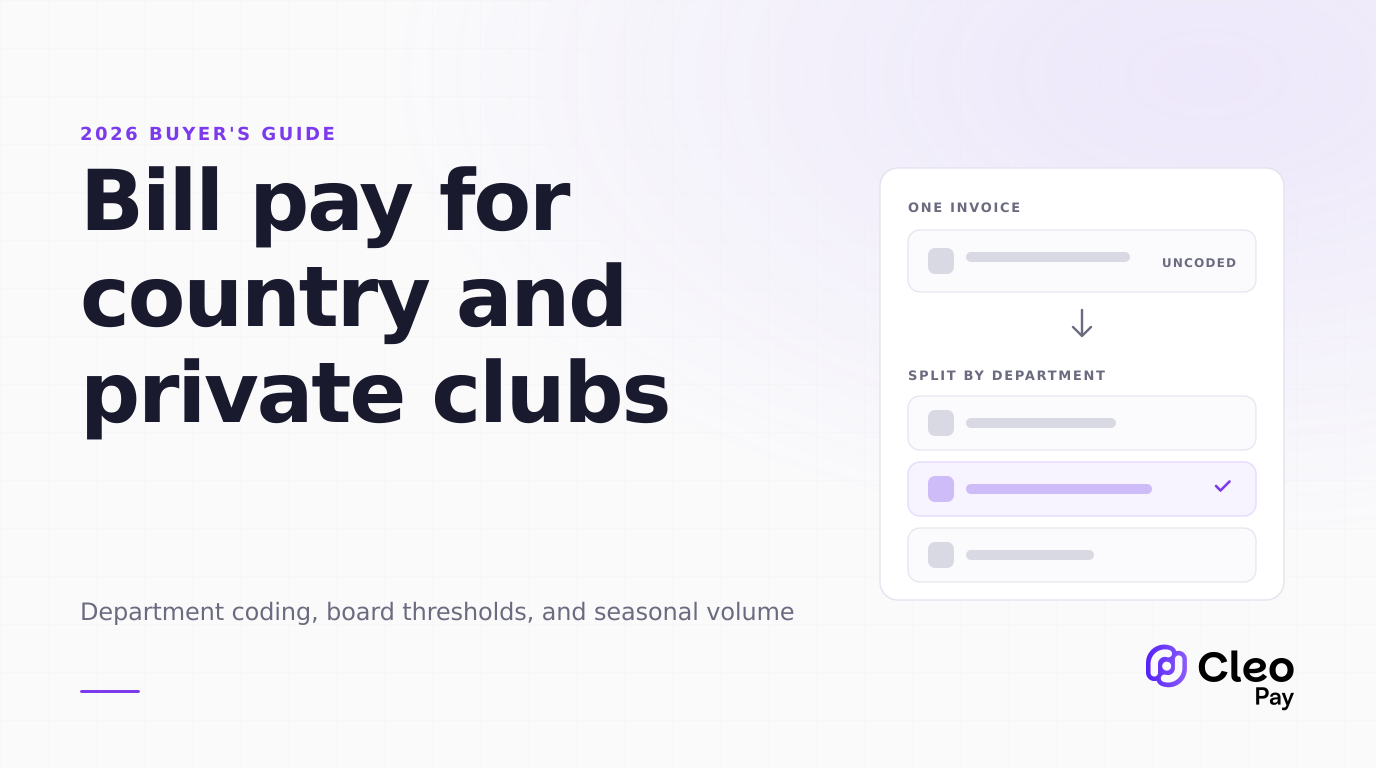
Departments are the unit of accounting, not locations. A hotel group thinks in properties. A club thinks in departments that all sit at one address: golf course maintenance, golf operations, F&B, clubhouse, pool, racquets, administration. A single invoice from a landscape supplier might split across course maintenance and grounds. An AP tool that can only code an invoice to one GL account per bill will generate work rather than remove it.
Approval authority is governed, not just managed. Clubs are member-owned and board-governed. There is usually a written spending policy with dollar thresholds: the department head approves up to one number, the general manager up to a higher one, the finance committee or board above that. Capital projects follow a separate path entirely, often through a committee that meets monthly. Software that offers a single approver or a flat two-step chain cannot express this.
Seasonality is extreme and predictable. In most of the country, a club's invoice volume in June bears no resemblance to its volume in January. Northern clubs may close entirely. That matters enormously for pricing, because per-user-per-month subscriptions charge you the same in the dead of winter as at peak season, while per-payment pricing tracks the actual work.
A large share of spend goes to individuals, not companies. Instructors, caddies, club professionals working on contract, musicians for member events, fitness trainers, and seasonal grounds help are frequently paid as independent contractors. That turns the AP system into a tax reporting system every January, which most club ERPs handle as an afterthought.
A club ERP is built around the member. The payables module is built around the check run. Neither is built around the department head who needs to approve a fertilizer invoice from a phone.
The eight criteria that actually matter
1. Department and sub-department coding on a single invoice
The test is simple: can one invoice be split across three departments, with different amounts, in one pass, without creating three separate bills? If the answer is no, your controller is doing that arithmetic by hand every week. Ask the vendor to do it live on one of your own invoices.
2. Approval routing that models your spending policy
You need thresholds, not just approvers. The right tool lets you say that anything under $500 in course maintenance goes to the superintendent, anything above $5,000 adds the general manager, and anything flagged capital routes to a separate chain regardless of amount. Ask specifically whether thresholds can differ by department, because in a club they always do.
3. It works with your club ERP rather than replacing it
Nobody rips out Jonas, Clubessential, Northstar, Buz, or Cobalt to fix accounts payable. Those systems run member billing, POS, tee times, and dining reservations, and replacing them is a multi-year project with no upside for AP. The realistic goal is a payables layer that sits alongside the club system and pushes coded, approved transactions into your general ledger.
This is the single most important question in the evaluation, and it is where you should be most skeptical. Third-party AP automation for club systems exists, and some vendors publish named integrations with club platforms. Others sync to QuickBooks or a general accounting package and expect the club system to be the member-side record only. Neither is wrong, but you need to know which one you are buying, and you need to see the sync run rather than hear it described.
4. Vendor onboarding that collects tax identity up front
The cheapest time to collect a W-9 is before the first payment, when the vendor still wants something from you. The most expensive time is the following January, when a seasonal instructor has moved and stopped answering email. A good AP tool makes the vendor onboard themselves through a link, enters their own banking and tax details, and cannot be paid until the record is complete. Our guide on collecting W-9s covers the mechanics.
5. 1099 preparation that falls out of the payment data
If payments are tagged correctly as they go out, year-end reporting is a review rather than a reconstruction. If they are not, someone spends January exporting the check register and sorting individuals from companies by eye. Ask whether 1099-NEC preparation and e-filing are included, or whether the tool hands you a report and wishes you luck.
6. Pricing that tracks your season
A club that processes 400 invoices in July and 60 in January is poorly served by per-seat pricing, because seats are exactly what you cannot reduce off-season. You still need the controller, the general manager, and the department heads in the system year round. Look closely at whether you are charged for approvers. In many per-user tools, anyone who approves a bill is a billable seat, which means a club with six department heads pays for six seats to get six approvals.
7. Payment rails you can choose per vendor
Not every vendor should be paid the same way. The turf supplier on net 30 has no reason to cost you an expedited fee. The emergency HVAC repair the day before a member-guest tournament does. A tool that supports one rail forces you to pay expedite pricing for everything or wait for everything.
8. An audit trail your board and auditor can read
Clubs get audited, and the finance committee asks questions. You want to be able to open any payment from the past three years and see the original invoice image, who coded it, who approved it, when, at what threshold, and how it was paid. This is ordinary in modern AP tools and rare in check-run workflows built on spreadsheets and a signature stamp.
The four categories of tools
Almost everything a club will look at falls into one of four buckets.
Club ERP AP modules are the incumbent. Their advantage is real and should not be dismissed: the vendor list, the member data, and the general ledger are already there, and there is no integration to build or maintain. The published feature sets cover invoice processing, vendor terms, prepaid allocations, and bank reconciliation. Where clubs tend to hit the ceiling is on the workflow side, specifically mobile approval by department heads, split coding, and vendor self-service. If your club is small enough that the controller codes and the general manager signs, this may be entirely sufficient, and you should not buy anything.
Generic AP automation is the largest category by installed base. BILL is the reference product, and it is genuinely good at the core job: capture the invoice, route it for approval, pay the vendor, sync to the ledger. It publishes three tiers at $49, $65, and $89 per user per month, plus a custom Enterprise plan. It handles W-9 collection and 1099 preparation. The friction for clubs is structural rather than functional. Pricing is per user, approvers usually count as users, and the coding model is built around a business with one operating structure rather than seven departments under one roof. There is a real ecosystem of third-party AP automation built specifically to sit on top of club ERPs, which is worth investigating if your club system is the non-negotiable part of your stack.
Spend management platforms lead with corporate cards and treat bill pay as an attached module. For a club with significant card spend across departments, the card controls can be genuinely valuable. The tradeoff is that the economics of these platforms lean on card interchange, and a club's largest payables, turf supplies, food distribution, utilities, insurance, and capital work, are mostly vendors who will not take a card or will surcharge for it.
Hospitality-specialist AP tools are the newest category and the narrowest. The case for them at a club is that the department-level coding, seasonal volume, and heavy contractor payment mix are the same problems restaurants, hotels, and venues already have, so the product is shaped around them. The case against is that they are smaller companies with fewer named integrations, so the club ERP sync question in criterion three needs a straight answer before you buy.
What each payment rail actually costs
Rail choice is where clubs quietly lose money, usually by defaulting to checks for everything or by expediting out of habit. The per-payment fees below are BILL's published 2026 rates, used here because they are the most widely published reference points in this category. Your own provider's numbers will differ, and you should ask for them in writing.
- Speed
- 1 to 3 business days
- Cost
- $0.59 per payment
- Best for
- Recurring vendors on net terms
- Speed
- Same business day
- Cost
- $11.99 per payment
- Best for
- Genuine exceptions only
- Speed
- Mail transit, typically a week or more
- Cost
- $1.99 per check
- Best for
- Vendors who refuse electronic payment
- Speed
- Immediate authorization
- Cost
- 2.9% of the payment
- Best for
- Vendors who accept cards at no surcharge
- Speed
- Typically several business days
- Cost
- $19.99 per wire
- Best for
- Overseas equipment and specialty suppliers
The arithmetic worth doing: a club sending 250 payments a month by check is spending real money on postage, stock, and the labor of a check run, before counting the fraud exposure of signed paper moving through the mail. Our breakdown of the cost of paying vendors by check works through that in detail for restaurants, and the math is the same at a club.
The 1099 problem clubs walk into every January
Clubs pay a lot of individuals. Tennis and golf instructors on contract, caddies, personal trainers, musicians and entertainers for member events, seasonal grounds help, and specialty trades all commonly receive Form 1099-NEC rather than a W-2. This is the part of club AP that quietly becomes a compliance workload, and 2026 changed the rules.
The One Big Beautiful Bill Act raised the Form 1099-NEC reporting threshold from $600 to $2,000 for payments made in 2026, reported in early 2027, with the threshold indexed for inflation from 2027 onward. For a club, that meaningfully reduces the number of forms, because a large share of contractor payments are small and occasional.
Two operational deadlines matter. Form 1099-NEC is due January 31, and unlike most information returns it has no automatic extension available. And the IRS mandatory electronic filing threshold is 10 information returns, counted across all form types combined rather than per form. A club filing six 1099-NECs and five 1099-MISCs is over the line and must e-file. Almost every club clears 10 without thinking about it.
The practical consequence for software selection: if your AP tool tags payments as reportable when they go out and files electronically at year end, January is a review. If it does not, January is a reconstruction project during the one month a northern club has no staff to spare. Our guide on paying contractors at scale under the new threshold goes deeper on building that process, and while it is written for agencies, the mechanics are identical.
A shortcut through the decision
For reference on pricing shape rather than as a recommendation, Cleo Pay's published tiers are Starter at $55 per seat per month with one seat and 20 payments included, Growth at $75 per seat per month with three seats (from $225) and 100 payments included, and Max at $99 per seat per month with five seats (from $495) and 300 payments included. Vendors receive payments free, and cardholders do not take a seat. The point of showing this next to BILL's $49 to $89 per user is not that one is cheaper in the abstract, because it depends entirely on your seat count and volume. It is that the two models scale on different axes, and a club with many approvers and seasonal volume should model both before deciding.
What implementation actually involves
The feature comparison is the easy part of this decision. The part that determines whether the project succeeds is the migration, and clubs consistently underestimate two pieces of it.
The first is the vendor master. Most clubs have accumulated years of duplicate records, vendors who changed names, and entries with no tax identity attached at all. Moving that list into a new system is the moment you discover how much of it is unusable. Plan for a cleanup pass, and use it as an opportunity to send every active vendor a self-service onboarding link so they enter their own current banking and tax details rather than having staff retype what is on file. Our guide to vendor onboarding covers how to run that without stalling payments.
The second is timing relative to your season. Do not implement in your peak month, and do not implement in December, when year-end close and 1099 preparation are already competing for the same person. For most northern clubs the natural window is late winter, once 1099s are filed and before the course opens. For year-round clubs in warmer markets, pick the shoulder period after your busiest season ends.
Ask the vendor for a named implementation contact, a written timeline in weeks, and a specific plan for the vendor master. A vendor who cannot produce all three has not thought about clubs.
Red flags in a demo
- The vendor codes their own sample invoice instead of one of yours. Bring three real invoices, including one that splits across departments.
- Approval thresholds are described as "configurable" without being configured on screen.
- The club system integration is a roadmap item, a partner referral, or a CSV export described with the word "seamless."
- Nobody can tell you whether approvers count as billable seats.
- The 1099 answer is a report you export rather than a filing they perform.
- Implementation is quoted without a named person, a timeline, or a data migration plan for your existing vendor master.
Run the evaluation
FAQ
The bottom line
Clubs sit in an awkward spot in the AP market. They are too departmentally complex for tools built around a single-structure business, too small to justify an enterprise ERP, and too invested in their club management system to replace it. That is why so many clubs are still running a check run in 2026.
The way through is not to find the tool with the longest feature list. It is to be precise about which of the eight criteria above actually cost you time, then test only those, on your own invoices, with your own thresholds, before you sign anything. For most clubs the honest shortlist is two products: whatever your club system already includes, and one dedicated AP layer that proves it can split-code an invoice and answer the integration question without hedging.
If a large share of your spend goes to individuals rather than companies, weight the tax identity and 1099 criteria above everything else. That is the work that comes back every January whether or not you planned for it.
Want to see it against your own invoices? Book a 20-minute walkthrough and we will code a real club invoice across departments, route it through your actual approval thresholds, and show you where the time is going. No slides.