Ask ten restaurant operators how they pay their vendors and you will hear ten different answers. Some still cut paper checks every Friday to Sysco and the linen company. Some log into Bill.com. Some pay the produce guy in cash when he drops a case of heirlooms out the back door. A few use QuickBooks Online's bill pay feature. The rest are somewhere in between, stitched together with spreadsheets, Venmo, and a bookkeeper who knows where the bodies are buried.
That patchwork is not a sign of disorganization. It is what happens when an operator tries to force generic B2B tools onto a business that has 40 vendors delivering perishable goods every week on 7-to-14-day terms while running on 4 to 6 percent net margins. Restaurant bill pay is its own category, and in 2026 the operators who treat it that way are the ones holding onto cash and closing their books on time.
This is a practical guide to how restaurants should actually handle bill pay this year: what the workflow should look like, which payment rails fit which situations, and what separates a modern AP stack from the check-and-spreadsheet model most kitchens still run.
Why restaurant bill pay is different
Compared to a generic small business, a restaurant's AP profile is unusually punishing:
- Vendor count is high. A single full-service restaurant typically pays 25 to 60 vendors a month. A five-unit group can clear 200. Most generic bill pay tools were designed for businesses that pay 10 vendors a month.
- Invoice cadence is weekly, not monthly. Sysco, US Foods, Performance Food Group (PFG), Baldor, Shamrock, Cheney Brothers, and the local produce house each drop invoices 2 to 5 times a week. Paper invoices get left on walk-in shelves. Drivers hand-write adjustments on the delivery slip. Line items move around between orders.
- Terms are short. Broadline distributors typically run net 14. Specialty produce like Baldor or Greenleaf is often net 7. Liquor distributors (Southern Glazer's, Breakthru Beverage, RNDC) are regulated by state, net 30 in California, net 7 to 15 in many other markets. Miss a payment and you lose the next delivery, which means you lose tomorrow's menu.
- Coding drives the P&L. A single Baldor invoice can hit five COGS subcategories (proteins, produce, dairy, dry goods, bakery). Coding matters for invoice categorization accuracy, and it has to happen fast, because line-item data is also what feeds your theoretical food cost in Restaurant365, MarginEdge, or xtraCHEF.
- Fraud risk is concentrated on checks. Hospitality is one of the most check-heavy verticals in the US economy. The 2025 AFP Payments Fraud and Control Survey continues to show checks as the single most targeted payment method year after year.
The anatomy of a well-run restaurant AP cycle
Strip away the tooling and the cycle has five steps. Each one is a place where most restaurants lose time, money, or accuracy.
1. Invoice intake
Invoices arrive by email, through vendor portals like SyscoSOURCE and US Foods Direct, on delivery slips stapled to cases of 1/20# produce bags, and occasionally as photos the GM texts to the bookkeeper. A modern intake layer accepts all of the above and normalizes them into a single queue. OCR extracts line-item data: item name, SKU, pack size, quantity, unit price, total. Paper and PDF become structured data.
If your intake is still "email everything to the bookkeeper and hope she sees it," you already know where the failures live: duplicate payments when the same invoice comes in twice, missed invoices on vendors who stopped emailing, and bills that age out past their terms.
2. Approval
Who signs off on a $4,200 short-rib order? Who is allowed to approve a one-off hood-cleaning bill from a new vendor? The answer should be encoded in software, not in a WhatsApp thread between the GM and the owner. Rule-based approvals (by vendor, by dollar amount, by GL account, by location) route invoices to the right person and log the approval for audit. For a single location this is table stakes; for groups it is how you prevent a rogue manager from committing the business to costs no one else knows about.
3. Coding and categorization
Every line item maps to an account in your chart of accounts. Doing this well is the difference between a P&L that tells you "food cost is 33%" and one that tells you "protein cost moved from 9.1% to 10.4% this month because the brisket price jumped $1.20/lb." The detailed breakdown lives in our restaurant chart of accounts guide, but the headline for bill pay is simple: if your AP tool cannot code at the line-item level, your books cannot tell you the truth, and neither can your recipe costing tool.
4. Payment
The rail you choose changes the cost, speed, and risk of every payment. More on this below.
5. Reconciliation
Paid bills have to match the bank feed and the GL. If reconciliation is a monthly scramble, your bill pay tool is not doing its job. A tool that syncs to QuickBooks, Restaurant365, or Sage Intacct in near real time turns the monthly close from a two-week project into a two-day review.
The invoice is not just a bill to pay. It is the richest piece of cost data your restaurant produces every week, and most operators throw 90% of it away by coding the whole thing to one COGS bucket.
The payment rails, and when each one fits
Most operators default to whatever they have always used. In 2026 there is a better answer for each situation.
- Speed
- 1–3 business days
- Cost
- $0.50–$1.00 per payment
- Best for
- Predictable weekly and monthly vendor payments. Should be the default for 70–85% of outbound payments.
- Speed
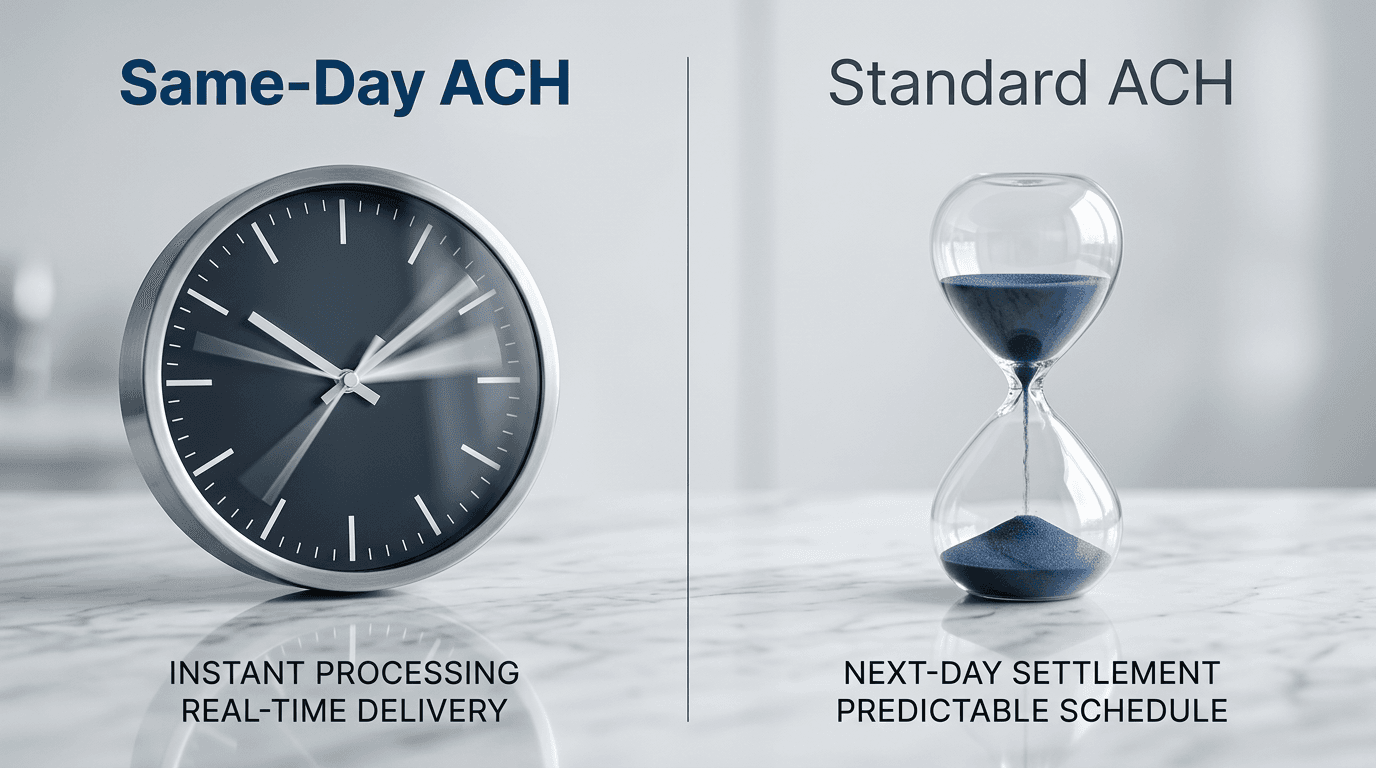
- Same business day
- Cost
- $1.50–$12 per payment
- Best for
- Vendors on hold, at-risk deliveries, urgent staffing-agency payments. Pay for speed only when speed unblocks something.
- Speed
- Instant
- Cost
- Fee absorbed by vendor; may earn 0.75–1.5% rebate for you
- Best for
- National vendors that accept cards: SaaS, marketing, linens, some distributors. Meaningful cashback on AP spend.
- Speed
- Same day, final
- Cost
- $15–$45 per wire
- Best for
- One-off large payments where finality matters. Not a default rail.
- Speed
- 3–10 days mail + cash time
- Cost
- $6–$22 fully loaded per check
- Best for
- Vendors who refuse ACH, very small local suppliers, landlords who insist. Should be the exception, not the default.
For the real numbers on why checks land at $6–$22, see our true cost of paying restaurant vendors by check post.
The inventory loop most operators miss
Here is the non-obvious point: AP data is inventory data. Every line-item unit price that flows through your bill pay system is the most current "last in" cost for that ingredient. When Baldor's organic strawberry price jumps from $26.50 to $34.00 a flat, that number needs to show up in your recipe costing the next day, not at month-end when the bookkeeper keys it in.
This is why restaurant-specific AP tools plug into Restaurant365, MarginEdge, xtraCHEF, Craftable, and similar costing layers. A correctly coded Sysco line ("40lb CAB Choice Chuck Shoulder, 6/case, $6.85/lb") is simultaneously:
- a GL entry into
COGS–Proteins–Beef - an inventory receiving transaction
- the current standard cost for any recipe that uses chuck shoulder
- the data point that flips the brisket sandwich from 28% to 32% theoretical food cost overnight
If your bill pay stops at "total invoice = $3,842.17, code to COGS-Food," you have cut the inventory loop. Theoretical food cost stays stale. Menu engineering stays guesswork. Prime cost drifts upward and no one sees it until the quarterly review.
What good looks like in 2026
If a peer operator asked you to audit their AP, here is the short list of things you want to see.
- Single intake channel. Vendors email invoices to one address. Paper invoices get photographed from the delivery truck. Everything lands in the same queue.
- Line-item OCR tuned for restaurants. Every item, every SKU, every pack size, every unit of measure captured as structured data, including handwritten adjustments from the driver.
- Restaurant-specific chart of accounts sync. The AP system respects your COA, not a generic one. It codes line items to COGS subcategories automatically, learns from corrections, and pushes clean data to QuickBooks Online or Restaurant365.
- Rule-based approvals. Thresholds by vendor, dollar amount, location, and GL account. Approvers get pinged on their phone and can tap to approve.
- Multiple rails in one place. ACH, same-day ACH, virtual card, and checks when you really need them, all from the same bill pay interface. Switching rails should be a dropdown, not a separate vendor relationship.
- Fraud controls on by default. Positive pay on checks. Vendor bank account verification at onboarding (see our vendor onboarding best practices). Dual control on payments above a threshold. Alerts when a vendor's banking info changes.
- Real-time book sync. Paid bills show up in QuickBooks within minutes, not at month-end. Reconciliation is continuous.
- Multi-entity support for groups. If you run more than one location, each entity's AP has to stay clean. Inter-company allocations and per-location approval routing are not optional. Our multi-location restaurant bill pay post goes deep on this.
Operator checklist: are you ready to modernize?
Tap each box that applies. Your answers save to this device, so you can come back and update as you make progress.
How Cleo Pay approaches restaurant bill pay
Cleo Pay was built for operators who have tried the generic tools and hit the same walls. What we do differently:
- Restaurant-aware OCR. Our intake handles Sysco, US Foods, PFG, Baldor, Shamrock, Cheney Brothers, Chefs' Warehouse, and the long tail of regional distributors out of the box. Line-item extraction, pack-size normalization, unit-of-measure conversion. Handwritten adjustments are flagged for review.
- Your chart of accounts, not ours. Cleo Pay syncs your QuickBooks Online chart of accounts and codes every line item to the right subcategory. Corrections teach the system for next time.
- One payment workflow. Pay by standard ACH, or same-day on Growth and higher plans. Paper checks are coming soon.
- Multi-location from day one. Per-entity books, per-location approval routing, consolidated vendor master. If you run a group, multi-location restaurant bill pay is a solved problem.
- Controls before money moves. Approval workflows by amount, and a warning when a bill looks like a duplicate.
See Cleo Pay for restaurants for the full product walkthrough.
FAQ
The bottom line
Restaurant bill pay in 2026 is not a back-office chore. It is the function that determines how accurately you see your P&L, how fast you close the month, how current your theoretical food cost stays, and how much cash you leave on the table to fraud, late fees, and missed discounts.
The operators who treat AP as a strategic lever (not a bookkeeping afterthought) are the ones who will stay profitable as food costs keep climbing. Pick your rails deliberately. Code at the line-item level. Get your vendors on ACH. And stop running the highest-leverage financial process in your business out of an email inbox.