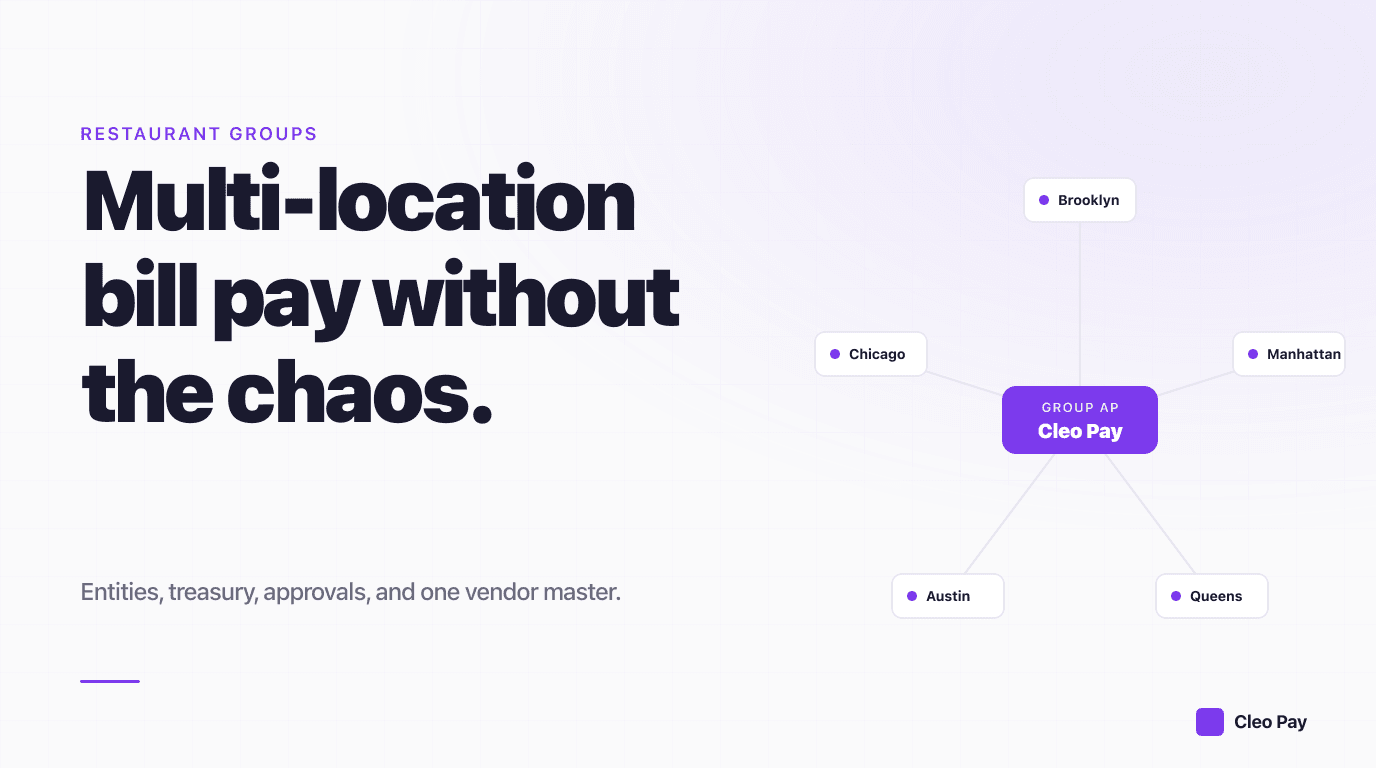
A single restaurant's AP is a puzzle. A five-location group's AP is a different puzzle entirely. Most operators do not realize the shift until they are living it, trying to pay Sysco at three locations out of three separate bank accounts with three different managers approving, and watching the bookkeeper drown in reconciliations.
We wrote a companion piece on the vendor operations side of multi-location payments, covering W-9s, vendor master data, and onboarding hygiene. This post is about the payment execution layer: the entity structure, the funding mechanics, the approval routing, and the inter-company allocations that have to work for a group to scale.
Why multi-location is categorically different
Running AP for one restaurant is a workflow problem: receive invoice, approve, pay, reconcile. Running AP for five restaurants is a structural problem. The difference comes from how hospitality groups are actually organized.
Each location is usually its own legal entity. Separate LLCs, separate EINs, separate bank accounts. This is true for operational liability reasons and because investors often have different stakes in different locations. A generic AP tool that assumes one company, one chart of accounts, and one bank account does not fit.
Vendors span multiple entities. Sysco delivers to all five locations, but each delivery is billed to the entity at that address. The vendor relationship is one-to-many: one Sysco account, five payable entities. Your AP tool needs to handle that without creating five duplicate vendor records.
Approval authority varies by location. The GM at Brooklyn might be allowed to approve produce invoices up to $2,000. The Manhattan GM might have a different limit. The owner wants to see anything above $5,000 anywhere. Approval rules have to be location-aware.
Coding differs by location. Locations often use the same chart of accounts template, but location tags (class or department in QBO) differentiate the data. Line items need to land in the right account AND the right location tag.
The group wants consolidated reporting. The individual locations produce their own P&Ls, but the owner looks at consolidated numbers. That means your AP data has to roll up cleanly across entities.
None of this is exotic. It is just not what most generic bill pay tools were built for.
The four structural decisions
Every restaurant group has to make four structural decisions about bill pay. The quality of the decisions predicts how painful AP will feel two years from now.
Entity model
Most operators set up each location as a separate legal entity for liability isolation. A minority (often franchisees under a single operating company) run multiple locations under one entity with class tracking to separate the P&L.
- Separate entities: cleaner liability, cleaner investor structures, but more complex AP (each entity has its own books, its own bank account).
- Single entity with classes: simpler AP, but liability mixes and investor structures get complicated.
Your AP tool has to support whichever structure you picked. If your tool forces a single-company model, you will find yourself running five parallel AP processes.
Treasury
Two common shapes:
- Per-location accounts: Each entity pays from its own bank account. Clean entity accounting, but no pooled cash, and the bookkeeper is logging in and out of five bank relationships.
- Consolidated treasury: A holding company funds payments and the individual entities settle up via inter-company accounting. Better cash management, but the books need to handle inter-company transactions correctly.
Groups typically start with per-location accounts and move toward consolidated treasury around 5-10 locations when the friction of the former outweighs the complexity of the latter. Your AP tool needs to support both shapes and handle the migration.
Approvals
Who approves invoices?
- Centralized: A finance lead at the home office approves everything. Consistent, but slow, and the home office loses visibility into operational context.
- Decentralized: Each location GM approves up to a threshold; anything above goes to the owner or finance lead.
- Hybrid (most common): Location GM approves operational AP (food, beverage, supplies) up to a limit. Finance approves anything non-operational or above the limit. Owner approves capital expenses and anything above $X.
Whichever you pick, it needs to be encoded in software. Approval-by-email-thread does not scale past two locations.
Vendor master
If Sysco is a vendor at all five locations, is Sysco one record in your AP system, or five?
- One record with location-specific sub-accounts: Cleaner reporting, easier onboarding, single point of truth for the bank info. Our preferred shape.
- Five separate records: Simpler for tools that cannot model the relationship, but creates data drift (same vendor, different spellings, different banking info over time).
The one-record-with-sub-accounts pattern is what a well-built restaurant AP tool supports. See our multi-location vendor payments post for the vendor master hygiene side of this.
The execution layer: what needs to work
Once the structural decisions are made, the execution layer has to handle all of it without creating work.
Invoice intake by location
Invoices arrive per location. Driver drops a slip at the Brooklyn back door, gets emailed to the Manhattan GM, gets faxed (yes, still) to the Queens location. The AP system needs to route each invoice to the right entity automatically, often based on the delivery address on the invoice itself.
Line-item coding with location tags
Every line item gets coded to a COGS subcategory AND a location tag. Protein on a Brooklyn invoice lands in the Brooklyn entity's COGS-Protein account. Same line on a Manhattan invoice lands in Manhattan's. Consolidated reporting at the group level shows both.
Approval routing by entity
The Brooklyn GM approves Brooklyn invoices. The Manhattan GM approves Manhattan invoices. The owner approves anything above the threshold at any location. Rules are expressed once and the system applies them.
Payment funded from the right account
If Brooklyn's invoice is $3,800 and Brooklyn has its own bank account, the payment pulls from that account. If the group runs consolidated treasury, the payment pulls from the holding company and books an inter-company transaction.
Consolidated vendor record, entity-specific payments
Sysco is one vendor in the system. When you pay a Brooklyn Sysco invoice, the payment references the Brooklyn entity's Sysco sub-account and sends to Sysco's bank info. When you pay a Manhattan Sysco invoice, same vendor, different sub-account, same bank info.
Sync to per-entity books
Paid bills sync to the right QuickBooks, Restaurant365, or Sage Intacct file. Brooklyn's QBO sees Brooklyn's payments. Manhattan's sees Manhattan's. Consolidated reporting happens at the reporting layer, not by cross-posting.
If your bookkeeper keeps a spreadsheet to track which vendor has which bank info at which location, your vendor master is broken and you will eventually pay a fraudulent ACH you didn't mean to send.
Common failure modes
The patterns that predict AP pain at multi-location groups:
- Duplicate vendor records across entities. Sysco gets spelled "Sysco," "Sysco Foods," and "SYSCO NY" in different QBO files. Bank info drifts. Duplicate payments creep in. Fix this early, before you have three years of data to clean up.
- GM bottlenecks. When the location GM is the only approver and she is on vacation, AP stops. Always have a backup approver configured.
- Inter-company messiness. If your AP tool does not model inter-company transactions, your books will not balance across entities. Reconciliation becomes a monthly puzzle.
- Reporting that only works per-entity. You will want consolidated AP aging, consolidated vendor spend, consolidated check register. If the tool only reports per-entity, you are back to spreadsheets.
- Fraud exposure multiplied. Every additional entity is another bank account, another set of check stock, another target. Centralized fraud controls (vendor bank verification, dual control, positive pay) have to apply across all entities.
How Cleo Pay handles multi-location
This is one of the problem spaces Cleo Pay was built for. Specifically:
- Multi-entity from day one. Each location has its own entity, books, and bank account.
- Single vendor master, entity-specific sub-accounts. Sysco is one vendor. Each location has its own sub-account under that vendor with its own bank mapping and sub-account number.
- Location-aware approval routing. Rules by vendor, amount, GL account, and location, combined however you need.
- Per-entity QuickBooks Online sync. Paid bills land in the right books with the right location tag.
- Consolidated reporting at the group level without losing per-entity integrity.
See Cleo Pay for restaurants for the full product walkthrough.
A practical rollout checklist
If you are scaling from one to five locations, tap each step as you complete it:
Groups who operationalize AP this way at location 1 do not hit the scaling wall. Groups who wait until location 3 or 4 end up paying consultants to clean up three years of duplicate vendors and miscoded line items.
FAQ
The bottom line
Multi-location restaurant bill pay is not "single-location bill pay, repeated five times." It is a different shape of problem, one that needs a tool built for multi-entity reality. Get the structural decisions right (entity model, treasury, approvals, vendor master) and the execution layer becomes boring in the best way.
The goal is for AP at the fifth location to take no more effort than AP at the first. That is what modern multi-location bill pay looks like, and it is entirely achievable in 2026 if you pick the right tooling before the complexity outpaces your team.